
A late hire is a teaching candidate who gets hired for a job close to or after the school year begins. Texas lets late hires start teaching as a paid intern before finishing all of their required training and observation hours — as long as those get completed within 90 business days of the hire date. The Texas Education Agency (TEA), the state agency that sets the rules for teacher certification in Texas, officially defines a late hire as someone who isn’t accepted into a certification program until within 45 days of the first day of instruction, or who is hired after that point or after the school year has already started. If a district wants to put you in a classroom in August or after classes are underway, the late hire provision is what makes it possible.
Key Takeaways
- A late hire is a candidate hired for a teaching position close to or after the start of the school year, after the normal pre-internship timeline has passed.
- In Texas, a late hire is defined as someone not accepted into a certification program before the 45th day before the first day of instruction, who is then hired after that day or after the school year has already begun.
- The late hire provision lets you begin a paid teaching internship before you've finished the training hours and classroom observation hours you'd normally complete first.
- You'll need to complete those remaining pre-service requirements within 90 business days of your hire date — if you don't, your intern certificate can be deactivated by TEA.
- The late hire rule covers the timing of your training and observation hours; it does not waive other requirements like being admitted to an Alternative Certification Program (ACP) and passing your content exam.
- Being a late hire is common and completely normal, especially for candidates hired in late summer or once school is already in session.
What does "late hire" actually mean?
The name makes it sound like you did something wrong. You didn't. "Late hire" is just a label for timing — it describes when you got hired, not how prepared you are or how good a candidate you are.
Here's the normal order of things. You enroll in an Alternative Certification Program (ACP) — a TEA-approved program for people who already have a bachelor's degree. You complete your early coursework, pass your content exam, and finish your required observation hours. Your program then issues your Statement of Eligibility (SOE), the document that shows you're cleared to be hired as a teaching intern. With your SOE in hand, you apply for jobs.
A late hire flips part of that order. A district offers you a teaching position late in the game — often right before school starts or after the year is already moving — and Texas has a rule that lets you step into the classroom right away and finish your remaining pre-service requirements while you teach.
It exists because real hiring doesn't always line up with a tidy timeline. Teachers resign in August. A new section opens in September. A district suddenly needs someone in front of students on Monday. The late hire provision is the state's way of saying: a qualified candidate shouldn't have to sit out a whole year just because the offer came late.
Who qualifies as a late hire in Texas?
TEA's definition has two parts, and you generally need both to be true:
- You weren't accepted into your certification program until close to the start of school. Specifically, you were admitted after the 45th day before the first day of instruction.
- You were hired for a teaching job in that same late window — either after that 45-day mark or after the school's academic year had already begun.
A quick example. Say the first day of school is August 12. The 45-day mark would fall in late June. If you enroll in your program and get hired in July or August — inside that window, or after classes have already started — you'd typically be considered a late hire.
If you enrolled back in the spring and finished your early requirements before that window, you're on the standard path, not a late hire. Same destination, different starting point.
If you've already been hired into a Texas teaching job, you can read more about how your job can still count towards your teaching internship in our complete guide: What If I'm Already Hired? A Texas Teacher's
Guide to Late Hires and DOI Hires.
What's different if you're a late hire?
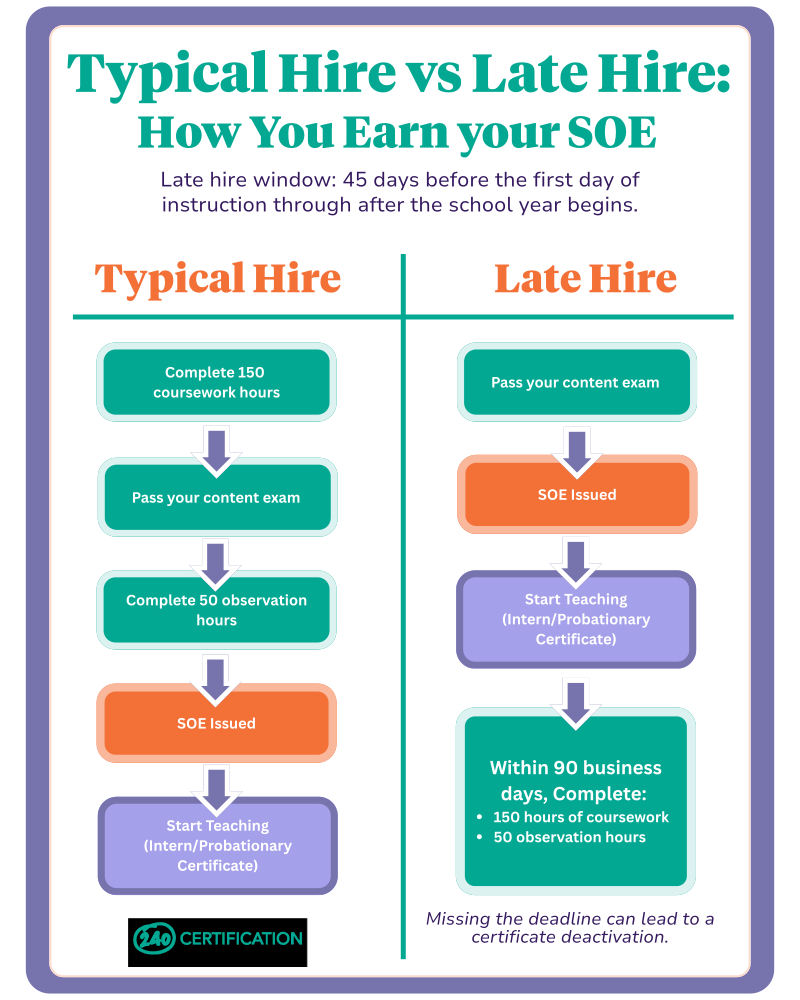
The big difference is sequence. On the standard path, you finish your training and observation hours first, then start teaching. As a late hire, you can start teaching first and finish that prep work during your internship.
There's an official term for that prep work: "pre-service" requirements. It just means the things you'd normally do before you start teaching — the required hours of training on how to teach (classroom management, lesson planning, and the like) and your observation hours, which are time spent watching experienced teachers work in real classrooms. Under Texas rules, a late hire can begin teaching under an intern or probationary certificate before finishing those, and then complete them within 90 business days of the hire date.
One thing to be clear about, so there's no surprise later: the late hire provision covers the timing of that training and those observation hours. It does not erase the other things that make you eligible for an intern certificate. You still need to be admitted to your ACP and meet the requirements for that certificate — including passing your content exam, the relevant Texas Examinations of Educator Standards (TExES) test for your subject. The late hire rule gives you flexibility on training hours, not a pass on knowing your content.
Why does this matter so much for August and September candidates?
Because this is exactly when most late hires happen. Districts do a lot of hiring right before the year starts and in the first few weeks once they see their real enrollment and staffing needs. If your offer lands in that stretch, the late hire provision is often the difference between teaching this year and waiting until next year.
If you're reading this in the middle of that scramble, don't stress. Getting hired late is one of the most ordinary things in alternative certification, and districts deal with it constantly. What matters is having a program that knows the rules cold and keeps your paperwork moving so nothing slips.
This is one of those moments where having real people in your corner pays off. At 240 Certification, you're paired with a Program Advisor who tracks your requirements and deadlines so you can focus on your students instead of decoding state rules. If you're hoping to teach this year, your first step is free — apply at 240certification.com/apply.
Does a late hire change how you earn your SOE?
A little — and it's worth understanding so the order makes sense.
Normally, your program issues your SOE after you've finished your early steps: starting your coursework, completing your observation hours, and passing your content exam. As a late hire, the timing of two of those — your training hours and your observation hours — shifts to after you start teaching.
The one piece that doesn't move is your content exam. You still have to pass it before you can be cleared and recommended for your intern certificate, because the late hire rule never waives knowing your subject. So in practice, a late hire can reach the point of being hired as an intern sooner, with the understanding that some of the work that usually comes first now gets finished during those first 90 business days. If you're unsure exactly where your SOE stands in a late hire situation, ask your Program Advisor — they can tell you precisely what's done and what's still ahead.
What happens if you don't finish your requirements in time?
This is the part to take seriously. The 90-business-day deadline isn't a suggestion.
If you don't complete your pre-service coursework and field-based experience requirements within 90 business days of your hire date, you're no longer qualified to hold the intern or probationary certificate. At that point, your program is required to notify TEA, and your certificate can be deactivated — which puts your teaching position at risk.
The good news: 90 business days is enough time when you have a plan and you start right away. The candidates who run into trouble are usually the ones who treated the deadline as far off and let the weeks slide. Front-load the work, stay in close contact with your program, and you'll be fine.
How 240 Certification supports late hires
We see late hires every single year, so this isn't new territory for us. When you come in as a late hire, your Program Advisor maps out exactly what you still need to finish and by when, and keeps the 90-business-day clock visible so it never sneaks up on you.
You'll also have help on the front end — getting admitted quickly, confirming your content exam status, and getting your documentation to TEA without delays. The whole point is to take the parts that feel overwhelming and turn them into clear, doable next steps while you settle into your classroom.
For more on how hiring fits into the bigger picture, see our Getting Hired article, and to understand the document that clears you to be hired in the first place, read Statement of Eligibility (SOE): What It Is and How to Get It.

Get hired this year.
If you're in the middle of a late hire situation — or you want to be ready before one lands in your lap — apply to 240 Certification for free. We'll look at your situation and tell you exactly where you stand.
Frequently Asked Questions
No. “Late hire” describes when you were hired, not the quality of your application. A lot of strong candidates come in as late hires every year — it usually just means a job opened up close to or after the start of school. Districts and programs handle this all the time.
As a late hire, yes — that’s the entire purpose of the provision. You can begin teaching under an intern or probationary certificate before finishing your pre-service coursework and observation hours, then complete them within 90 business days of your hire date. You do still need the other pieces that qualify you for the certificate, including passing your content exam.
You have 90 business days from your hire date to finish your remaining pre-service coursework and field-based experience hours. If you don’t complete them in that window, your intern certificate can be deactivated, so it’s worth starting on day one.
Yes. Once you’re hired into a qualifying teaching position and issued your intern or probationary certificate, you’re serving your internship — the same full-school-year experience every ACP candidate completes on the way to a standard certificate. The late hire status affects how you start; it doesn’t change what the internship is.
Most often in late summer and the first few weeks of the school year, roughly July through September, as districts fill vacancies and adjust staffing once students arrive. That timing is exactly why the late hire provision exists.
You don't have to figure this out in the middle of a hiring rush on your own. If a district is interested in you — or you want to be ready before one is — apply to 240 Certification and get your own Program Advisor to walk you through every step: 240certification.com/apply.
Have a specific situation you want to talk through first? You can reach an Admissions Advisor at admin@240certification.com.