
Quick Answer
Observation hours — officially called field-based experiences — are time you spend in real classrooms watching and taking part in the work of teaching before you become the teacher of record. In Texas, the state sets this requirement, not your program: the State Board for Educator Certification (SBEC), whose rules the Texas Education Agency (TEA) enforces, requires 50 clock-hours of field-based experiences for candidates entering certification on or after September 1, 2024. At least 25 of those hours must be interactive, where you actively take part in classroom activities, and up to 25 can be completed in more flexible ways, including approved video observation. Completing these hours is one of the first things you’ll do in your program, because they’re one of the requirements for your Statement of Eligibility (SOE). Your Alternative Certification Program (ACP) — the program you complete because you already have a bachelor’s degree — verifies your hours and issues your SOE, which is what lets you get hired into your teaching internship year.
Key Takeaways
- Observation hours are officially called field-based experiences, and you'll hear both terms used — they mean the same thing.
- Texas requires 50 clock-hours of field-based experiences for candidates who enter certification on or after September 1, 2024; the state sets this number, not your program.
- At least 25 hours must be interactive (engaged) hours, where you actively participate in classroom activities rather than only watching.
- Up to 25 hours can be flexible (non-engaged) hours, completed through approved video observation or by serving as a substitute teacher, teacher of record, or educational aide.
- You complete your field-based experiences early — before your teaching internship or clinical teaching begins — and they count toward your required coursework and training hours.
- Your program tracks and verifies your hours and your written reflections, so you don't have to manage the requirement with the state on your own.
What Are Observation Hours, Exactly?
Observation hours are exactly what they sound like at the start: time you spend in real classrooms, watching certified teachers do their work. Their official name in Texas rules is field-based experiences, and you'll see both terms used — including by us. They mean the same thing.
But "observation" only tells half the story. Some of your hours are spent watching. Others are spent doing — taking part in classroom activities under the direction of your program. That mix is built into the requirement on purpose, and we'll break it down below.
Either way, this is a normal, early part of becoming a teacher through alternative certification. You're learning the job by spending time around people who already do it well, before it's your turn to lead the room.
Why Does Texas Require Observation Hours?
The state wants future teachers to spend real time in a classroom before they're responsible for one. That makes sense. You wouldn't want to walk into your first day having never seen the work up close.
Here's why field-based experiences matter:
- They show you what teaching really looks like. Reading about classroom management in your coursework is one thing. Watching a teacher quiet a noisy room in ten seconds is another. These hours connect the theory to the real thing.
- They build your toolkit before you need it. You'll pick up strategies you'll use in your own classroom — routines, transitions, ways to explain hard ideas. Most teachers borrow their best moves from someone they once watched.
- They prepare you for your internship. Walking into your teaching internship year with real classroom hours already behind you means you're not starting completely cold.
Your coursework teaches you the "why" of teaching. Your field-based experiences show you the "how."
How Many Observation Hours Do You Need in Texas?
You need 50 clock-hours of field-based experiences if you enter certification on or after September 1, 2024.
This number is set by the state — by SBEC's rules in the Texas Administrative Code, enforced by TEA. Your program doesn't get to lower it. A program can choose to require more than the state minimum, but the floor is set in Austin, not by 240 Certification or any other ACP.
One note in case you've seen a different number: Texas raised this requirement. The older rule called for 30 hours, and candidates who entered before September 1, 2024 could finish under that legacy rule. If you're applying now, you're under the current 50-hour requirement.
What's the Difference Between Engaged and Non-Engaged Hours?
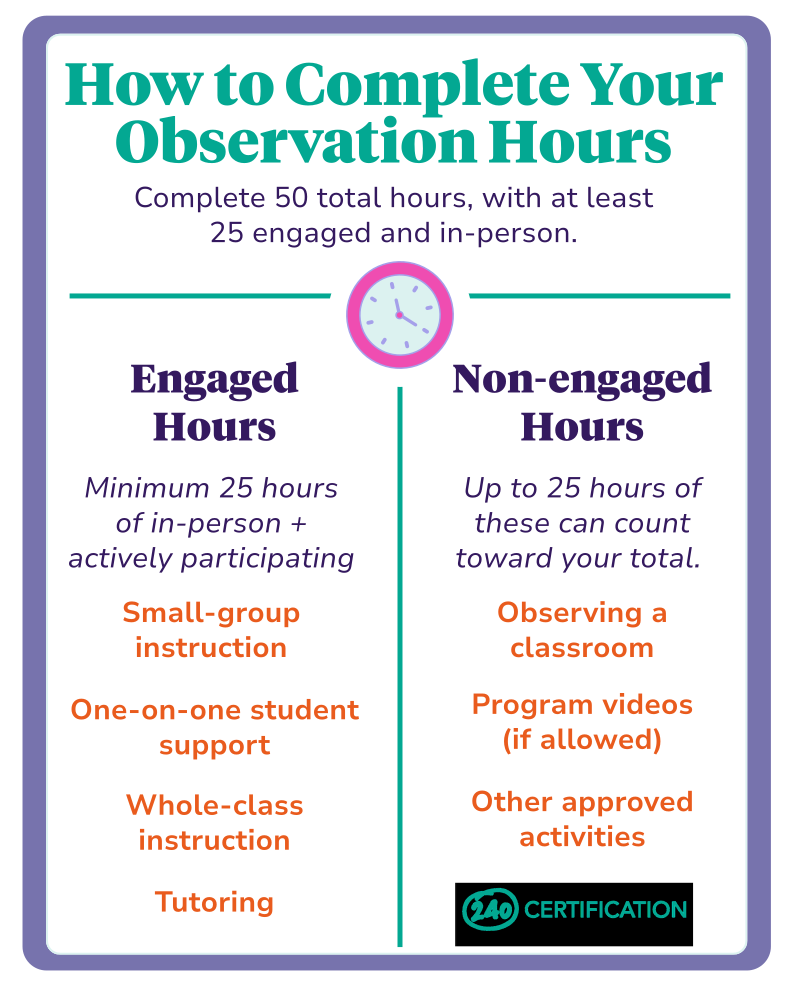
Your 50 hours aren't all the same kind of hour. Texas splits them into two buckets, and knowing the difference helps you plan.
Engaged hours (the interactive 25). At least 25 of your hours must be interactive. During these, you actively take part in instructional or educational activities — you're not just sitting in the back watching. These happen in real, accredited Texas schools, in classrooms led by content-certified teachers, with actual students. You also write a short reflection on each experience.
Non-engaged hours (the flexible 25). Up to 25 of your hours can be completed in more flexible ways. This is the bucket that gives working adults breathing room. These hours can come from:
- Approved video or online observation
- Serving as a substitute teacher
- Serving as a teacher of record
- Serving as an educational aide
You can mix and match within that flexible bucket. For example, you might do 15 hours through approved video observation and another 10 hours serving as a substitute teacher — as long as the total flexible hours stay at or under 25.
In short: at least half of your hours are hands-on and interactive, and up to half can be completed in ways that fit around a busy life. Don't stress about hitting all 50 in a single way — that's not how the requirement is built.
When Do You Complete Your Observation Hours?
Field-based experiences come early. You need to finish all 50 hours before your program can issue your Statement of Eligibility (SOE) — the document that shows you're eligible to be hired as a teacher intern and start your internship year. They also count toward the larger pool of coursework and training hours your program provides, so they're not extra work piled on top.
Here's roughly where they fall in the process:
- You enroll in your ACP and start coursework.
- You complete your field-based experiences (your 50 observation hours) and pass your content exam — the Texas Examinations of Educator Standards (TExES) test for the subject you want to teach. These are both requirements for your SOE, and the order you finish them in doesn't matter. You can complete your observation hours before your content exam, after it, or work toward both at the same time.
- Once you've met the early requirements, your program issues your SOE.
- You get hired into a teaching job that counts as your internship.
Your field-based experiences are one of the boxes you check on the way to that SOE. For the full picture of how everything fits together, see our article Statement of Eligibility (SOE): What It Is and How to Get It.
If you're ready to get started, your first step is free — apply at 240certification.com/apply. Once you're enrolled, you'll be paired with a Program Advisor who walks you through exactly how to complete and log your hours.
What Should You Actually Watch For?
Your hours are most valuable when you treat them as more than a box to check. You'll get the most out of them by paying attention to a few specific things:
- Classroom management. How does the teacher set expectations and handle disruptions? Watch the small routines — how students enter, where they put their work, how transitions happen.
- How concepts get explained. Notice how a teacher breaks a hard idea into pieces, and what they do when a student doesn't get it the first time.
- Pacing and timing. See how a lesson moves from start to finish, and how the teacher reads the room to speed up or slow down.
- Relationships. The best classrooms run on trust. Watch how teachers talk to students and build that connection.
Take notes — you'll need them for your written reflections anyway, and the strategies you see will become the strategies you use, often sooner than you'd expect.
How 240 Certification Supports Your Observation Hours
Figuring out field-based experiences on your own can feel like one more confusing requirement on a long list. That's where your program comes in.
At 240 Certification, you'll have real people supporting you through this step. Your Program Advisor explains what counts toward your engaged and flexible hours, points you to approved observation options, and tracks your hours and reflections so you always know where you stand. You're not guessing whether you've done enough or whether your hours will be accepted — we handle the verification piece for you.
You don't have to figure this out alone. Apply to 240 Certification and get your own Program Advisor: 240certification.com/apply.

Ready to Start Your Hours?
Your observation hours are one of the first steps in your program, and you don't have to sort them out alone. Apply to 240 Certification for free, and your Program Advisor will walk you through exactly what counts and how to log it.
Frequently Asked Questions
Yes. “Field-based experiences” is the official term in Texas certification rules, and “observation hours” is the everyday name people use for them. You’ll hear both. They refer to the same requirement.
No. At least 25 of your hours must be interactive, hands-on hours in a real classroom. But up to 25 can be flexible hours, which you can complete through approved video observation or by serving as a substitute teacher, teacher of record, or educational aide. Many candidates use a combination to fit the hours around a full-time job.
The state updated the rule. Candidates who entered certification before September 1, 2024 could complete the older 30-hour requirement, but candidates entering on or after that date complete 50 hours. If you’re applying today, plan for 50.
Sometimes. If you’ve started another ACP, some of your completed hours may carry over, but transferring hours is never guaranteed — it depends on what you completed and how it was documented. Some programs also charge a fee just to review your hours for transfer. This comes up a lot, so it’s worth asking about early. Talk to an Admissions Advisor at admin@240certification.com, and see our article Can I Transfer from Another Certification Program in Texas? for more.
The interactive observation hours are part of your training, not a paid teaching role. Some of your flexible hours can come from paid roles you may already hold — like substitute teaching or working as an educational aide — but you’re not paid simply for observing. The full-time paid teaching comes later, during your internship, after you earn your SOE.
You're closer to the classroom than you might think. Field-based experiences are one of the most approachable steps in the whole process — you're learning by watching and doing, before any of the real pressure is on you.If you're ready to stop wondering and start moving, apply here: 240certification.com/apply.