

Applying to an Alternative Certification Program in Texas
Quick Answer
Your first goal is to pick a TEA-approved Alternative Certification Program (ACP) that best fits you and the support you need. Admission is based on state requirements like your bachelor’s degree, GPA, and subject-area coursework, but programs may have extra steps too.
After you apply, you’ll submit official transcripts and complete any program requirements needed for admission. The ACP will review your application and, if you meet the qualifications, send you an invitation into the program. Once you accept your invitation and enroll, you can start coursework and begin working toward test approval.
Key Takeaways
- Only Texas Education Agency (TEA) approved programs can recommend you for certification.
- Don’t just choose the fastest option. Choose the program that will support you through the hard parts and help you stay on track.
- Official transcripts must be used because they verify your degree, GPA, and coursework.
- Extra admission steps are often meant to prepare and support you, not make it harder.
- There’s a difference between applying, being invited, and being enrolled. Coursework and testing steps only begin after you enroll.
Table of Contents
How do I choose the right certification program?
Picking an Alternative Certification Program (ACP) matters because this program will support your training, testing, teaching internship, and the final steps to become fully certified. That is a huge responsibility! You don’t want to just trust anyone with this important journey.
Start with this: make sure the program is TEA-approved.
If it’s not approved, it can’t recommend you for certification in Texas.
So before you apply anywhere, double-check that the program is on TEA’s approved list. TEA this information on their website here so you can verify programs and compare them.
What questions should I ask before choosing a program?
Use this checklist to compare programs and choose a program that best fits what YOU need:
1. Do you offer the certification area I want?
Make sure they offer the subject and grade level you’re wanting to teach.
For example: If you want to teach elementary grades, make sure the program offers the TExES Core Subjects EC-6 certification for early childhood through 6th grade.
If you want to teach high school English, they need to offer TExES English Language Arts and Reading 7-12 for grades 7th through 12th.
Unsure on what certification area matches the subject and grade level you want to teach? Feel free to reach out to our Admissions Advisors at admin@240certification.com. They will be happy to help you figure out what certification area you need.
2. What’s the program’s format?
Is the program online, in person, or a mix of both (hybrid)?
This matters because your schedule, learning style, and available time will affect which format you can realistically keep up with.
3. How is the learning structured?
Is it self-paced (asynchronous), where you work on your own schedule? Or is it scheduled (synchronous), where you have to show up to live sessions or meetings?
This affects how quickly you can move. Self-paced courses can let you go faster when you have the time, while scheduled sessions follow a set pace and meeting times.
4. What kind of support will I have, and how do I reach someone?
Pay attention to how easy it is to get help. Will you have a real person who knows your situation, or will you be sent to general support each time? Also look for clear details like how you can reach them (phone, email, text) and what a typical response time is.
This makes a big difference in how confident you feel and how quickly you can move through the process, especially when deadlines or hiring timelines come up.
For example, at 240 Certification, you’ll have real people supporting you from the start. You can talk to your Admissions Advisor while you apply, and once you’re enrolled, you’ll be paired with your personal Program Advisor who stays with you through the program.
5. What does test prep look like, and will it cost extra?
Every program is required to have a test approval process, which means you’ll need to complete certain steps before you can register for your content exam.
It helps to know up front what you’ll be expected to do and whether test prep is included. Your content exam is one of the biggest milestones, and passing it keeps you moving toward your Statement of Eligibility (SOE) and getting hired.
A few good things to find out are:
1️⃣ What do I have to complete before you approve me to test?
2️⃣ Is test prep included in the program, or is it an extra cost?
6. What does it cost and how do payments work?
Look for a clear breakdown of the total cost and your payment options, like monthly plans or upfront pricing. Also ask about common extra fees, like testing fees, certification application fees, and background check costs.
Knowing the full cost ahead of time helps you plan, avoid surprises, and choose a program you can stick with all the way to certification.
How to Enroll in a Texas ACP?
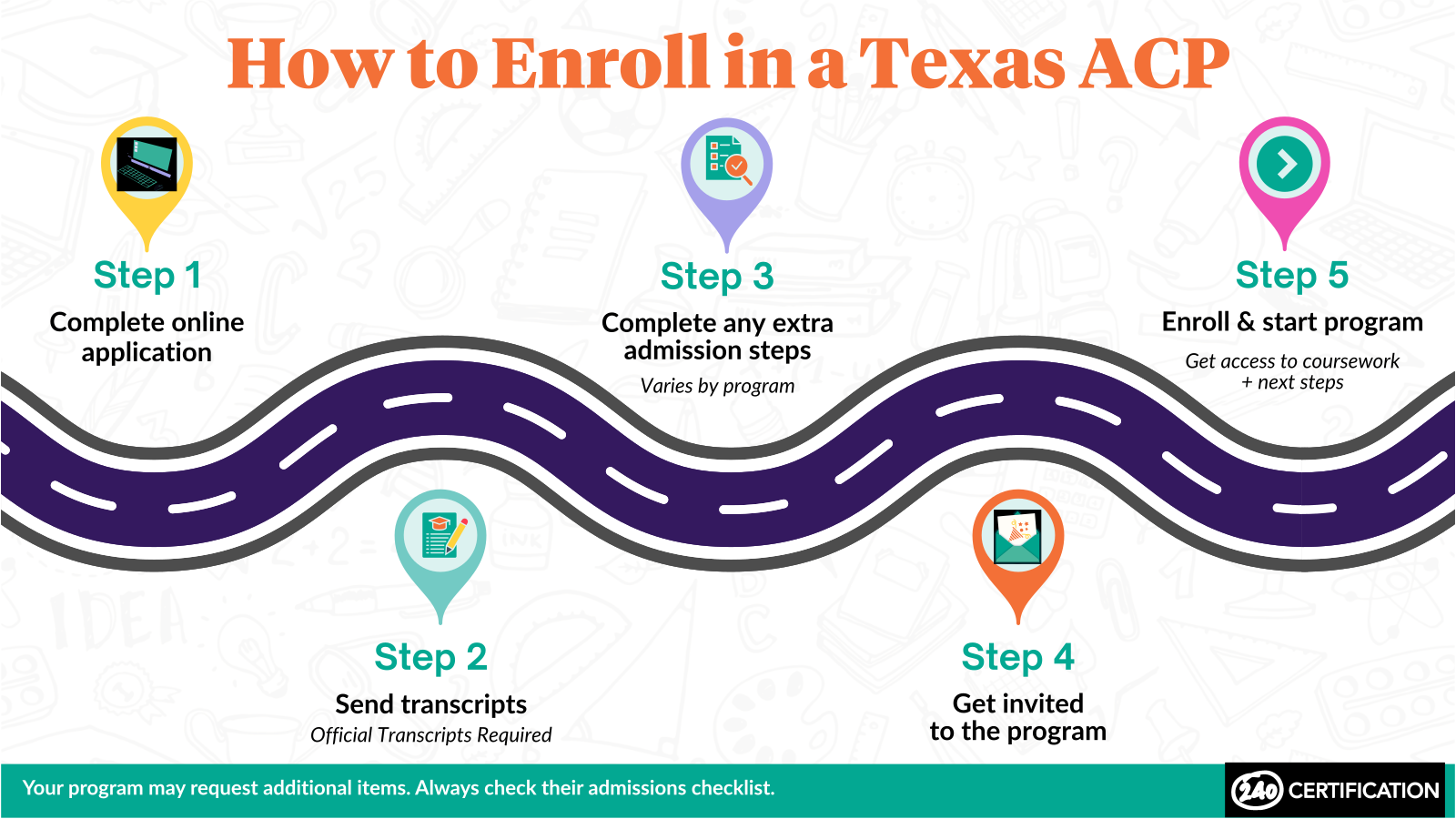
Most programs follow the same basic enrollment steps:
- Apply to the program
- Submit your documents (especially official transcripts)
- Complete any extra program steps
- Be accepted and sent an invitation
- Accept the invitation and officially enroll
Now let’s cover what Texas requires at a minimum.
Basic Admission Requirements
Every TEA-approved Alternative Certification Program (ACP) must follow the state requirements to screen applicants. Programs can add their own standards, but they can’t skip the basics.
Here are the main requirements you’ll see in every program:
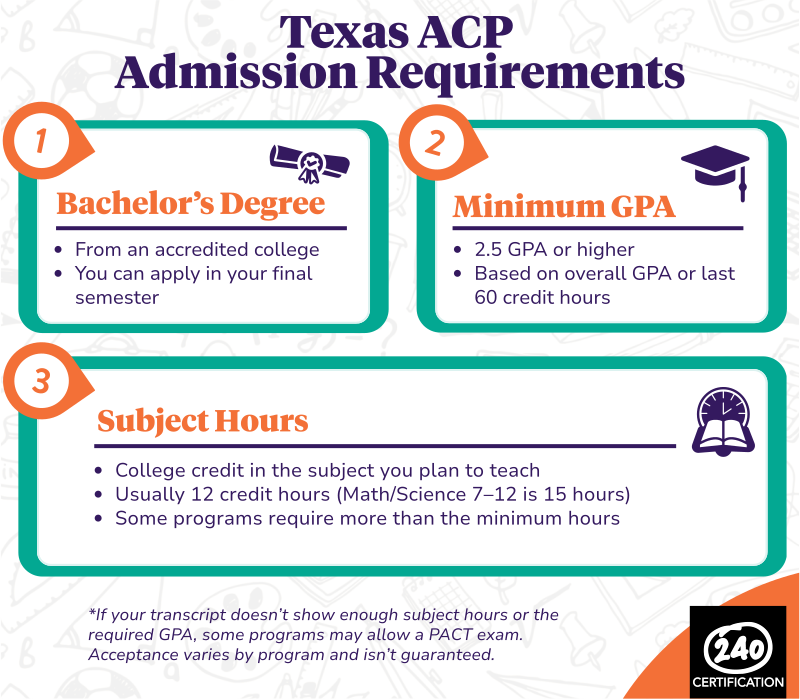
1) You need a bachelor’s degree
You must have a bachelor’s degree from an accredited college or university to become a teacher in Texas. (Most public universities and well-known colleges are accredited.) If you’re not sure if your college is accredited, you can learn how to check in our FAQs below.
Still in college? You may be eligible to enroll during your final semester through contingency admission. Read more about contingency invitations in our FAQs, too.
2) You need a 2.5 GPA
You’ll also need a 2.5 GPA, either:
- overall OR
- in your last 60 credit hours
Not sure if you have a 2.5 GPA? Don’t stress. We cover that a little further down here.
3) You need enough subject-area coursework
Texas also requires you to show your content knowledge. This means proving you know the subject you want to teach. You show this by having enough college coursework in that subject area.
The minimal requirements are:
- 12 credit hours in the subject area you want to teach, OR
- 15 credit hours for math or science at or above Grade 7
For example, if you want to teach Social Studies 4-8 (that’s social studies for grades 4th through 8th grade), you would need to have 12 credit hours of social studies coursework on your college transcripts.
Your program will check your college transcripts for these hours. But the Texas Education Agency (TEA) is the one that sets the rules for which classes count, not the program.
What if I Don’t Meet the GPA or the Subject-Hours Requirements?
If you don’t meet the GPA requirement or the subject-area hours, your ACP may ask you to take a Pre-Admission Content Test (PACT) to qualify for admission.
PACT is used to help you qualify for an ACP when your transcripts don’t meet the GPA or credit-hour requirements.
Your TExES content exam is the certification test for the subject and grade level you want to teach.
So they’re serving two different purposes: admission versus certification. Taking and passing the PACT exam for your subject and grade level is another way to prove your content knowledge if your transcripts don’t show enough. You can read more about PACT here.
Can programs require extra admission steps?
The Texas Education Agency (TEA) sets the minimum admission requirements, but programs can add their own admission steps too.
If you see extra steps, don’t automatically assume it’s a red flag. In many cases, a program that asks for a little more up front is focused on YOUR preparation — helping you start strong, stay confident, and succeed long-term and not just quick admission.
Some examples of extra admission requirements could be:
- Higher GPA standards
- Higher standards for subject-hour coursework
- An interview
- A writing sample
- References
- Extra coursework requirements
If we can leave you with one piece of advice, it’s this: Don’t pick a program just because it feels like the easiest route. We know that can be tempting. But you’re not just trying to start — you’re trying to finish strong. Choose the program that makes you feel prepared, supported, and ready for the classroom.
Becoming Enrolled: What It Is and Why It Matters
After you apply, the program will review your application and see if you meet the admission requirements. If you’re accepted, they’ll send you an invitation to join.
To become officially enrolled, you’ll need to say “yes” to that offer in writing. This might look like clicking an acceptance button, signing a form, or replying to an email. Enrollment matters for two reasons.
1) Enrolling is a real commitment
Once you enroll, you and the program are choosing to work together to get you certified. Switching programs later can be slow and stressful. That’s why it’s important to choose a program that best fits you and gives you the support you need to succeed.
2) It unlocks the next steps
Enrolling is also when things really start moving. You can start your coursework and begin working toward test approval, which you need before you can sign up for your content exam.
Commonly Asked Questions
If you’re finishing your bachelor’s degree, you can still start researching Alternative Certification Program (ACP) programs and even be able to enroll and begin parts of the program.
Texas allows contingency admission, which lets you start an ACP during your final semester, but you have to finish your bachelor’s degree by the end of that semester.
With contingency admission, you can begin program training, like coursework, and may even be approved to take your certification exam, but you can’t start your paid teaching internship yet. You’ll learn more about your internship on the next page.
Your degree must be officially conferred (meaning awarded and posted by your college) before your ACP can recommend you for an intern or probationary certificate.
If you’re not sure if your college is accredited, you can look your school up in the U.S. Department of Education’s school database and check that it lists an accrediting agency. Then, check TEA’s list of accepted accreditors to make sure that agency is listed.
Transcripts
When you apply, transcripts are one of the first things you’ll submit. Programs use official transcripts to verify your degree, GPA, and subject-area coursework (the classes connected to what you want to teach).
Most schools offer electronic delivery through their registrar’s website, often using services like Parchment or National Student Clearinghouse.
Some schools may also offer an official paper transcript that’s mailed or available for pickup through the registrar.
If you’re on a tight timeline, though, electronic delivery is often the quickest option.
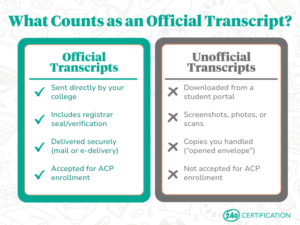
You’ll usually hear two terms when requesting transcripts: official and unofficial transcripts. They can look similar, but they aren’t treated the same.
Official transcripts (the one you need)
Official transcripts are certified versions of your academic record. It includes the school’s verification (like the registrar’s seal and/or signature) and is sent directly from the college or university to the program, or delivered as a secure electronic transcript.
Plan to order official transcripts for your application. This is the version programs will ask for during the application process.
Unofficial transcripts (good to recognize, but not what you’ll use)
An unofficial transcript is typically a printout or download from your student portal. These are not accepted for formal admission decisions because they’re student-handled and don’t include official verification
Quick heads up: Pictures, copies, or scans of an official transcript are typically treated as unofficial. And if a transcript comes in a sealed envelope, opening it usually makes it no longer official.
PACT (Pre-Admission Content Test) Exam
The PACT (Pre-Admission Content Test) is an admissions test some candidates need to qualify for an Alternative Certification Program (ACP). It is not the same as a certification exam.
You might need PACT if your transcripts don’t show the required GPA or the required subject-area credit hours. Basically, it’s a way to show content knowledge when your transcript doesn’t clearly show enough.
One important note: Using PACT instead of GPA or coursework is not guaranteed. Programs decide whether and how they accept it.
If your program tells you that you need a PACT, you can register through the Texas Educator Certification Examination Program website (the same website used for the certification exam registration).
You will create an account, select the correct PACT for the certification area you are pursuing, and pay the testing fee.
If you’re not sure which PACT to take, don’t guess. Reach out to your program first, so you register for the right exam and don’t waste time or money.
Transferring Programs
Transfers are possible, but they’re not automatic. You’ll still need to apply to the new program, meet their admission requirements, and be accepted.
Here’s what transferring usually looks like:
- Complete the new program’s application steps.
- When your new program prompts you, you’ll submit transfer documentation from your previous program, called a TEA Candidate Transfer Form. This form has sections for you to complete and sections your previous program must complete.
- Wait for confirmation from the new program that your transfer paperwork has been received and processed.
Want to know if any previous credits can transfer to your new program? We go deeper into that on the Your Statement of Eligibility (SOE) page. Read more about that here.
International Degrees
You’ll need a course-by-course credential evaluation from an approved service rather than sending regular transcripts if your bachelor’s degree is from outside the U.S.
Your program will use the evaluation to verify your degree and review your coursework for the certification area you’re applying for.
It’s a report that translates your international college record into a U.S. format. It shows your courses, how they compare, and your U.S. GPA equivalent. It also confirms your degree and the date it was awarded.
Your evaluation should include:
- your overall GPA equivalent
- your degree award date (month/day/year)
- a signed evaluation from the service provider

Ready to start your Texas teaching journey?
You bring the passion. We’ll bring the plan and walk with you every step of the way.